Reconsider your need to travel to Sri Lanka !

Safety and Security

Terrorism

Terrorism is a threat throughout the world. You can find more information about this threat in our General Advice to Australian Travellers.

Civil Unrest/Political Tension

We advise you to reconsider your need to travel to Sri Lanka at this time because of ongoing civil unrest, the volatile security situation and the very high risk of further attacks by the LTTE. There have been attacks against aid workers. Attacks occur frequently and further attacks can happen at any time, anywhere in Sri Lanka, including the south. Australians could inadvertently become victims of violence directed at others.
Tensions between the Government of Sri Lanka and the Liberation Tigers of Tamil Eelam (LTTE) are high. There has been a significant escalation in the number of serious incidents of politically motivated violence, including in tourist areas in the centre and south of the country. On 2 January 2008, the Government of Sri Lanka announced it would withdraw from the ceasefire agreement it signed in 2002 with the LTTE. The security situation could deteriorate further without warning.
You should pay close attention to your personal security and monitor the media and other local information sources for information about possible new safety or security risks.
On 27 November 2006, the LTTE indicated that it would pursue an independent state through renewed struggle rather than negotiation. Road access to the north of the country, including to Jaffna, has been restricted because of intermittent fighting at Muhamalai. A State of Emergency was declared by the Government of Sri Lanka on 13 August 2005 following the assassination of the Foreign Minister and remains in effect. The State of Emergency gives additional powers to security forces including the authority to establish road blocks and impose curfews. Further powers were given to the security forces under emergency regulations introduced in December 2006.
Air and ground attacks in late 2007 in areas held by the LTTE escalated the conflict in the north. On 2 November 2007, the LTTE announced that the leader of its political wing was killed in an aerial attack by the Sri Lanka Air Force. These events may increase the risk of further attacks by the LTTE in any part of Sri Lanka, including Colombo.
On 5 December 2007, 15 civilians on a public bus in North Central Province were killed and 23 injured in a roadside bomb attack.
On 28 November 2007, an explosion in a clothing shop in a Colombo suburb killed 20 civilians and injured 34. These attacks appear to have targeted civilians. Also on 28 November 2007, a suicide bombing at a government ministry in central Colombo killed two people and injured a further two. On 2 January 2008, a roadside bomb targeting a military bus killed four people and injured 23 in central Colombo. The majority of those killed and injured were civilians. On 8 January 2008, a Sri Lankan government minister was killed and 10 civilians injured in a roadside bomb attack targeting the minister’s convoy. The attack took place on the road between Colombo’s international airport and the city centre. A second blast occurred in a phone booth near major hotels in the Fort district and the headquarters of the Sri Lankan Air Force headquarters.
Although tourists have not been targets of politically motivated violence, the LTTE have undertaken attacks at locations frequented by tourists, including the international airport in Colombo and the Temple of the Tooth in Kandy. There has been a significant escalation in the number of serious incidents of politically motivated violence throughout Sri Lanka, including in tourist areas in the centre and south. On 22 October 2007, the LTTE launched a ground and air attack on the Sri Lanka Air Force base at Anuradhapura, near the popular tourism facilities in the cultural triangle. The attack killed over 30 people and destroyed several military aircraft. Several bombs were reportedly dropped on the base during the attack. On 15 October 2007, the LTTE attacked a military camp located in Yala National Park, a popular tourist location, killing eight people. On 16 October 2007, a military vehicle hit a landmine in Yala National Park in Southern Province killing one and injuring three people.
Attacks could occur at any time and in any place, including infrastructure associated with the Sri Lankan Government such as military establishments, public transport, airports, sea ports, oil depots and public buildings, as well as political offices of anti-LTTE Tamil organisations. Nearby locations could sustain collateral damage. Potentially affected locations also include shopping malls, clubs, hotels, restaurants, bars, movie theatres, schools, places of worship, embassies, tourist areas (including national parks), markets and outdoor recreation areas, major sporting events and religious festivals.
Events of political significance, including elections, could be catalysts for violence and civil unrest. You should avoid all demonstrations and large public gatherings as they may turn violent.
You should be particularly vigilant on and around anniversaries and days of national significance such as May Day (1 May), Vesak (which falls in May), the Kandy Esela Perahara Festival (which falls in August), Heroes week (late November), the Tamil and Sinhala New Year festivals (13-14 April), the anniversary of the 2002 cessations of hostilities (22 February) and of the first LTTE suicide bombing (5 July), as militants have in the past used such occasions to mount attacks. Security forces discovered an explosive device and components for an explosive device in central Colombo in early October 2007. On 23 August 2007 police arrested five men for allegedly planning an attack on the Kandy Esela Perahara Festival. There were further arrests on 26 August 2007 following the recovery of an unexploded bomb on a street in Kandy.
On 28 May 2007 a bomb blast near a Sri Lankan Air Force base south of Colombo killed at least seven civilians and injured more than 35 other people, including Sri Lankan Police personnel. On 29 April 2007 Tamil Tiger aircraft bombed the Sri Lanka Air Force (SLAF) base at Ratmalana and an oil refinery in Colombo. On 26 April 2007 the Bandaranaike International Airport near the capital Colombo and its access roads were temporarily closed when Sri Lankan troops at the nearby SLAF base at Katunayeke fired anti-aircraft guns following reports a Tamil Tiger aircraft was in the area. The LTTE launched aerial attacks on the SLAF base on 26 March 2007, forcing the temporary closure of Bandaranaike International Airport, and on the SLAF base at Palali, Jaffna on 23 April 2007, killing armed forces personnel. The Sri Lankan Government has warned more aerial attacks could occur, including, but not limited to, in the High Security Zone in Colombo 1 and 2 suburbs and parts of Colombo 3 suburb where a number of international hotels are located.
You should avoid anti-aircraft batteries and their immediate surroundings, including high-rise buildings, especially during blackouts. New batteries have been established in central Colombo in areas frequented by tourists, including hotels. . In the event of anti-aircraft fire you should stay indoors in a secure location because of the risk of falling projectiles and shrapnel. You should also avoid travelling at night time when anti-aircraft fire is more likely to occur. On 29 April 2007, 14 people were injured and buildings were damaged after anti-aircraft weapons were fired over Colombo.
In the event of a Sri Lankan Government-enforced security related blackout, Australian government officials have been advised to avoid anti-aircraft batteries and their surroundings, including tall buildings and to take cover in a secured area for protection against projectiles, likely to be on the ground floor of an internal room with solid concrete walls and ceiling and no, or limited, windows. If unable to leave a tall building, they have been advised to take cover in an inner room with solid walls using heavy furniture for additional overhead protection. They have been further advised to stay indoors for at least one hour after the cessation of firing of any anti-aircraft guns.
Due to the on-going conflict, the SLAF base at Katunayeke could be targeted at any time. The co-located international airport could be closed without warning and commercial aircraft could be at risk, particularly at night. In light of the increased threat, some airlines have suspended flights to Colombo or changed flight schedules suspending commercial late night flights. We recommend you contact your airline to confirm flight details.
Recent reports indicate that terrorists may be planning suicide attacks against the headquarters of the Sri Lanka Air Force (SLAF) in Sir Chitampalam A Gardiner Mawatha in central Colombo and the main SLAF fighter wing at Katunayake, collocated with Bandaranaike International Airport, the country’s main international airport.
Truck bombings could occur at any time in any part of Sri Lanka. You should exercise extreme caution, maintain high personal security awareness and avoid locations known to be targeted by terrorists in Sri Lanka. On 24 July 2007 a roadside bomb targeting a military bus in Mannar district killed nine soldiers. On 24 May 2007 a road side bomb targeting a military bus was detonated in the Fort Area of the Colombo 15 suburb near the port and naval base, killing one soldier and injuring several others, including civilians.
We are aware of media reports that the High Security Zone Residents’ Liberation Force (HSZRLF) has threatened to attack civilian targets in the south including hospitals and dams. The Ellalan Force, which claimed responsibility for the bombing of civilian buses on 5 and 6 January 2007, issued a statement on 21 January threatening further attacks.
Northern areas (including Wilpattu National Park): We advise you not to travel to the north of Sri Lanka, including the area north of the highway between Puttalam, Anuradhapura and Polonaruwa and Wilpattu National Park. An explosion in Wilpattu National Park in May 2006 killed seven visitors. The Government of Sri Lanka and the LTTE have engaged in significant battles in the area between Mannar and Omanthai near Vavuniya, as well as Muhamalai in Jaffna. In October 2007, the government began a new offensive against LTTE positions north of Giant Tank near Adampan in Mannar district.
East and south-eastern areas (including Yala National Park): We advise you not to travel east of Pollonaruwa town on the A11 road or to points east of a straight line between Polonaruwa town and the South Coast, passing through Badulla including Yala National Park. On 16 October 2007, the LTTE attacked an army camp in Panama in Ampara district in the east. A day earlier, the LTTE attacked a military camp in Yala National Park in Southern Province near Hambantota. Eight people were killed. Vehicles travelling in Yala National Park hit landmines in October and November 2007. Vehicles have reportedly been attacked with improvised explosive devices in the vicinity of Yala National Park and Kataragama in the South-East.
There have been incidents of violence against aid workers. On 20 August 2007, a member of the Danish Demining Group was shot dead in Jaffna, while his co-worker was injured. On 23 June 2007 an aid worker with the Danish Refugee Council was shot dead in Jaffna. On 2 June 2007, two volunteer Red Cross workers were abducted from a train station and murdered. On 13 June 2007, an expatriate aid worker with Mercy Corps was shot on a beach at the Club Oceanic Hotel in Trincomalee.
The Government of Sri Lanka and the LTTE have engaged in significant battles in Mannar district between Adampan and Madhu, as well as near Omanthai in Vavuniya district and in the general vicinity of Trincomalee. In November 2007, the Government of Sir Lanka attempted to breach the LTTE’s defences in Jaffna. Military strikes have also occurred in the Batticaloa, Ampara, Mannar, Mulaitivu, Killinochchi and Hambantota districts. Travellers have inadvertently been caught up in these actions. An attack on a passenger train on 6 June 2007 in Batticaloa district derailed several carriages and caused injuries to a number of civilians. A passenger train was attacked with an improvised bomb on 18 December 2007 in Trincomalee, causing no injuries.
Reports indicate a pro-government Tamil paramilitary faction has threatened aid workers operating in Eastern Province.
If you are already in the “Do Not Travel” areas described above, including the Wilpattu or Yala National Parks, and concerned for your safety, you should consider departing if it is safe to do so. Politically motivated violence including assassinations, bombings in public places and on roads is escalating and there is widespread civil unrest. Communal and inter-ethnic tensions in these regions are very high and further violence is highly likely, particularly between Muslim communities on the east coast and pro-government Tamil paramilitaries.

Crime

There is a danger of kidnapping for ransom of foreign nationals in Sri Lanka, including in Colombo. All Australians in Sri Lanka, particularly those of Sri Lankan Tamil origin, should ensure that appropriate identification is carried at all times.
Violent crime continues to increase, including sexual assault and robbery. Policing in remote areas is often hampered by a lack of resources and poor infrastructure.
There have been incidents of violence against aid workers. On 2 June 2007, two volunteer Red Cross workers were abducted from a train station and murdered. On 13 June 2007, an expatriate aid worker with Mercy Corps was shot on a beach at the Club Oceanic Hotel in Trincomalee.
Petty crime such as pick-pocketing and bag snatching occurs, particularly on public transport.

Local Travel

How much metformin can kill you
Due to the volatile security situation in Sri Lanka, Australian government officials and dependants have been advised to limit travel (particularly at night), maintain a high degree of awareness at roadblocks and checkpoints and avoid using public transport. Australian diplomatic and consular staff have also been advised to exercise heightened security vigilance, avoid travel to locations that may be potential targets and curtail all non-essential travel. Anti-aircraft batteries and their immediate surroundings, including high-rise buildings, should also be avoided. In the event of anti-aircraft fire you should stay indoors in a secure location because of the risk of falling projectiles and shrapnel.
Security personnel may impose curfews, roadblocks and security checks at short notice across the country, and may require proof of identification, such as your current passport.
There can be lengthy delays when travelling to the airport as a result of checkpoints established by the security forces. Sections of the road to the airport are occasionally closed at night, requiring all traffic to be diverted along narrow local roads. Travellers should allow adequate time for security checks on the road to the airport and maintain a high degree of security vigilance if diverted from the main road along the narrow local road system.
Check points between government held areas and “uncleared areas”, (i.e. areas controlled by the LTTE) including on the main A-9 highway which links the north and south of the country, can be closed without notice. The checkpoint at Muhamalai, the entry point to Jaffna, has been closed since 11 August.
Transport conditions throughout Sri Lanka are hazardous. There are a high number of road deaths and injuries, particularly on inter-city buses and three-wheeler taxis. The standard of driving and vehicle maintenance is poor. There have been a number of fatal accidents on Sri Lankan railways in recent years.
Marked and unmarked landmines are widespread in parts of the north and east, especially in Vanni, Jaffna and along the A9 road in the north.
On 28 December 2005 the Government of Sri Lanka announced arrangements for foreigners seeking to enter the uncleared areas of the north and east which are presently under LTTE control. Foreign staff of diplomatic missions, international organisations and international non-government organisations accredited with the Sri Lankan Ministry of Foreign Affairs will be allowed to cross entry and exit checkpoints into uncleared areas without restriction. All other foreigners must seek approval from the Sri Lankan Ministry of Defence before being allowed to enter uncleared areas. For advice on the location of uncleared areas, you can contact the Sri Lankan Ministry of Defence on telephone number (+94 11) 243 3215.
Road access between Jaffna and the rest of Sri Lanka has been closed since 11 August 2006. The LTTE has refused to guarantee the safety of shipping in waters around Jaffna. On 9 November 2006, LTTE Sea Tigers attacked Sri Lankan Navy ships escorting a passenger ferry from Trincomalee to Jaffna. The LTTE launched a suicide attack against a cargo vessel in Jaffna on 21 January 2006. Australians in Jaffna who wish to depart should do so by air.
The waters around the northern and eastern coast of Sri Lanka are declared restricted zones by the Government of Sri Lanka. Government security forces have fired upon unauthorised vessels in coastal areas. In September 2006 a vessel was destroyed in waters beyond the territorial sea.
Piracy occurs in the coastal areas of Sri Lanka. The LTTE hi-jacked a Jordanian cargo vessel off the north-east coast in December 2006. See our travel advice on shipping and ports for more information. The International Maritime Bureau issues weekly piracy reports on its website.

Airline Safety

Due to the on-going conflict, the SLAF base at Katunayeke could be targeted at any time. The co-located international airport could be closed without warning and commercial aircraft could be at risk, particularly at night. We recommend you contact your airline to confirm flight details.
Passengers on international flights to and from Australia are only allowed to carry a small amount of liquids (including aerosols and gels) in their carry-on baggage. You can find out more information at the Department of Infrastructure, Transport, Regional Development and Local Government website. Similar restrictions apply to flights in an increasing number of countries. Contact your airline for further information.
If you have concerns about the safety standards of a particular airline or aircraft, we recommend you research the airline or aircraft through organisations such as Australia’s Civil Aviation Safety Authority Pristiq price with insurance and the International Civil Aviation Organisation (ICAO). The Department of Infrastructure, Transport, Regional Development and Local Government has published fact sheets on security for air travellers. When staff at Australia’s overseas missions are advised not to use particular airlines due to safety concerns this will be included in travel advice.
The European Union (EU) has published a list of airlines that are subject to operating bans or restrictions within the EU. The United States Federal Aviation Administration (FAA) through its foreign assessment program focuses on a country’s ability, not the individual airline, to adhere to international standards and recommended practices for aircraft operations and maintenance established by ICAO.
source:
http://joyceheyzer.spaces.live.com/Blog/cns!79F27886F50B9A13!1961.entry?wa=
wsignin1.0

Floods everywhere

Cheapest aciclovir cream Floods devastate lives across globe (11 January 2008)

Purchase parietal pleura Floods have wreaked havoc across the world this week as heavy rain hit Southern Africa, Australia, the US, Sri Lanka and Britain.

An Australian woman was killed after flood waters in New South Wales swept her car from a causeway on Saturday.

Thousands were left stranded in eastern parts of the country after some of the worst flooding the country has seen in more than 20 years following a long period of drought.

Aid agencies warned of the risk of diseases from dirty water after floods devastated parts of Zambia, Mozambique and Zimbabwe at the beginning of the week.

Chris McIvor, Save the Children’s director in Mozambique, said: “The warning bells have been ringing for two weeks. The flooding could get a lot worse very quickly.

“We know that what children will need most urgently is shelter, clean water to drink and enough food to eat.”

Officials estimated that millions had been forced to flee their homes and several people are believed to have died.

The downpour has also drowned livestock and left many fields waterlogged, raising the prospect of food shortages in the months to come.

Monsoon flooding forced about 30,000 people in eastern Sri Lanka to take refuge in temporary shelters, according to officials.

Homes in the eastern district of Ampara, a largely flat agricultural area that was hit by the 2004 tsunami, had to be abandoned after heavy rain began on Monday.

Governor Arnold Schwarzenegger declared a state of emergency in several parts of California after heavy rain and strong winds lashed the state, causing flash floods, mudslides, heavy snow and power cuts.

Torrential downpours also came to Britain at the end of the week, leaving homes and businesses in Ireland and north Wales hit particularly hard by floodwater.

Kate Martin

source:
http://www.edie.net/news/news_story.asp?id=14035&channel=0

#68 Mambo’s Surf Cafe

2013 update:

Our local correspondents regret that they are unable to provide any further photos, comments or news from this #68 establishment.
Aygestin generic name This is due to the fact that “Mambo’s” management (or their manager) have banned them Order bentyl 10mg from their premises. Even a young child wasA?threatenedA?by him (a Mr. “Ranga”) and a group of A?”Mambo” supporters. We deeply regret this weirdA?behaviourA?and sad incident. And will no longer support or mention this particularA?establishmentA?in future.

However, anyone else isA?herebyA?invited to contribute to this page and post.
Below is an extract from our earlier post.

Arugam.info has not left the boys from Hikkaduwa out for any other reason, but for the fact that their brilliant place is not situated on the main road as such.
In fact, #68 Mambo’s can’t be accessed by road at all: The well developed complex is actually located on the sandy beach, near famous surf point itself. Only a 4×4 can be driven there, across the beach front.

A bit of history:}
Mambo is a house hold name in Hikkaduwa, on the South Coast.
The two resorts are Sri Lanka’s main surfing destinations.
But they have opposing seasons.
About 2003 clever business man Mr. “Mambo” decided to offer all year round facilities to his mainly Japanese guests. When a local offered an ‘inaccessible’ place for sale at Arugam Bay it was time to act and the place was swiftly purchased.
Some nice bungalows were build, a restaurant constructed and best of all:
A good, new PARTY PLACE was born.

Some locals, Arugam Bay – or mostly distant PottuVille people – did not see the benefit such a new, western orientated approach would bring to the area and there has been some predictable opposition.
It has much to do with different life styles – and nothing religious or political of course.

The boys from the South do know how to attract tourists, how to make them happy, how to have a good party and how to deal with western girls:
East Coast guys may have some learning and catching up to do.
Of late, Arugam.info has been informed that Mambo may develop a branch at nearby Peanut Farm – half way between Arugam Bay and Panama.
Another brilliant choice, if so!
Because, away from all this local jealousy, in the middle of an undeveloped, peaceful and beautiful area any visitor and tourist can and will really be able to enjoy a true party in unspoiled nature settings. Without unwanted local interferences.
Arugam.info certainly welcomes #68 Mambo as a valuable contribution to the services the Bay can offer.

UL without EK

Bad News also for Arugam Bay.
Emirates Airlines used to send some pilots on a R & R surf stay to the Bay to recover from work stress situations. Bad international vibes about heavy handed attitudes, too.
Read the full article:

Emirates to end Lanka partnership

Epivir-hbv price

By Sanjay Dasgupta
BBC News


Emirates aircraft

Together the two airlines are major carriers to Sri Lanka

Emirates Airlines has announced that it will not renew its management contract with Sri Lanka’s national carrier after March this year. Emirates owns a 43% stake in Sri Lankan Airlines and runs it under an agreement with the Sri Lankan government.

The pull-out announcement follows a row over ticketing between the chief executive of Sri Lankan Airlines and the Sri Lankan government in December.

Relations between the two soured significantly following the incident.

Withdrawn

In December Peter Hill was appointed chief executive of Sri Lankan Airlines by Emirates to run to run Sri Lanka’s national carrier.

Soon after his appointment, he refused a request from the Sri Lankan President, Mahinda Rajapaksa, for 35 tickets on a flight from London to Colombo.

Sri Lankan President  Mahinda Rajapaksa

The president needed to travel at short notice with 35 other passengers

The president, who was in London for a private visit, was rushing home in order to be able to attend a crucial session of Parliament.

But Mr Hill refused the request as the flight was over-booked. Shortly afterwards, Mr Hill’s working visa and residence permit were withdrawn by the Sri Lankan authorities.

Talking to the BBC, Mr Hill said the incident “had some bearing” on Emirates’ decision not to renew its contract.

“Basically the flights had been full for several months and we weren’t able to accommodate that number of people – we were talking about 35 seats here.

“And so we asked them if there was a possibility that only the president and his close relatives could travel, and we probably would have been able to accommodate them with three or four seats.

Personally I feel that after 10 years of putting the airline on the right road to success and profitability, it was a disappointing end
Sri Lankan Airlines Chief Executive Peter Hill

“But obviously we weren’t able or prepared to offload 35 previously booked customers, basically taking the whole of our premium cabin and 17 seats in economy, at that short notice.

“That’s not the way that commercial airlines run their businesses, and we’re a commercial airline.”

Mr Hill said soon afterwards his work permit and the residents permit were withdrawn.

The original contract between Emirates and Sri Lankan Airlines had been in operation for 10 years, and would have come up for renewal in April.

Price of brand name wellbutrin Mr Hill said Emirates had made a set of proposals for renewing the contract more than 18 months ago, but had heard nothing from the Sri Lankan authorities.

While Emirates and Sri Lankan Airlines insist their parting has been amicable, Mr Hill said that it would nevertheless send the wrong signal to international investors.

“Personally I feel that after 10 years of putting the airline on the right road to success and profitability, it was a disappointing end,” he said.

“But the message it sends out to the international community, I think, is not a good one.”

For its part Sri Lankan Airlines says it will have to put together a plan to continue running its operations from April, which it says it is capable of doing.

source:
http://news.bbc.co.uk/2/hi/south_asia/7175527.stm

Magul Maha Viharaya – Lahugala

Sri Lanka : Magul Maha Viharaya – Lahugala

Permanent Mission of Sri Lanka – Geneva – Switzerland

04th January 2008

by Florence WickramageA?A?

The day was bright and the sea a glittering turquoise blue with a strong wind sweeping over it. Some people standing on a beach saw an object shining with the rays of the sun being tossed to and fro by the ocean waves. They waited till the object advanced towards the shore and was surprised to see that it was a gold-gilded canoe carrying a beautiful damsel in it.

Order fincar They ran towards the palace and informed the King that a golden-canoe was coming ashore with a beautiful princess in it. The King hastened towards the beach but found the boat gone. “Ko Kumari” inquired the King? The boat had been swept away by strong winds towards the village Komarigama (coined with the words Ko kumari) in Arugam Bay. (The canoe had not been able to anchor at Kirinde due to its rocky environment). On inquiries made King Kavantissa was informed that the damsel in the canoe was Princess Devi, daughter of King Kelanitissa of Maya Rata, who was offered as a sacrifice to appease the wrath of the sea-gods as the sea waters threatened to drown villages.

King Kavantissa then hastened to meet the Princess and married her in keeping with traditional customs, and she became Queen Vihara Maha Devi. ” The Magul Poruwa” said to be of the Royal couple could be seen amongst ancient ruins in a temple called “Magul Maha Viharaya” in Lahugala. Princess Devi’s canoe had been washed ashore at Arugam Bay ( coined from the words “ara -gama”) and not Kirinde. This is folklore — as related to us by the Chief Priest of the ancient Lahugala Temple Ven. Hulanduwe Ratanasara Thera.

Hydrochlorothiazide cost cvs

Driving along the Wellawaya-Moneragala road after passing Siyambalanduwa for another seven miles one could reach Lahugala where Magul Maha Vihara or Ruhunu Maha Vihara lies.

We visited Magul Maha Viharaya which is in ruins today. Ven. Hulanduwe Ratanasara Thera the 5th generation descendent of the Uva-Wellassa lineage which administered the Magul Maha Vihare is the present Chief Priest. Lahugala belonged to the Ruhunu Kingdom of ancient Lanka. The entire Vihara complex had covered an extent of around 10,000 acres where ruins of a palace, moonstone, monastery, bo-maluwa, stupas, ponds etc. were found scattered all over. A headless white marble Buddha statue was seen lying horizontally in one part of the ruins, which sometimes people step on, Ven. Ratanasara said, taking us round the complex.

The history of this temple goes back to the time of King Dathusena who ruled Anuradhapura from 516 AD to 526 AD. The pillar inscription testifies the founder of the Vihara as King Dathusena. The language and the script can be dated to the 14th century.

There is also a stone wall three to four feet in height. This reminds of a fortress which was erected to protect from outside attack. There is also an entrance to the fortress. The moonstone found on the left side has unique features with a row of elephants and creepers followed by a row of lotus petals. The Chief Priest explained that among other unusual features, the row of elephants in the moonstone with their mahouts was exceptional. In this moonstone with three to four in height and five to six feet wide, the row of elephants has a man following an elephant with his goad clinging on to the animals. This moonstone is said to be the only one of its kind in the country.

There are rock pillars similar to Lovamaha Prasada in Anura-dhapura. There is also ruins of a Dagaba about 30 feet in height. There are three rows of steps leading to the Dagoba on three sides and on the lift side is Bodhighara and also rock inscription protected by an iron railing.

The Ven. Thera showing us round the ruins of the vihara complex observed that there were several villages round the temple and people had fled due to unrest. With the ongoing peace process many were returning to their original places. A perahera has been planned along with other religious ceremonies to be observed during Poson the Ven. Thera said.

We then visited Muhudu Maha Viharaya at Arugam Bay. The wide white beach was endless, stretching for miles and miles. There were excavated ruins and stone pillars which provided evidence of an ancient kingdom which had flourished. The Chief Priest of Muhudu Maha Viharaya, Ven. Kataragama Siriratana Thera supporting Queen Vihara Maha Devi’s story as related to us by the Lahugala Viharaya Chief Priest, showed us partly ruined stone statues two of which were believed to be of King Kavantissa and Viharamahadevi. The moonstone which had been in existence near a ruined “Buduge” had been removed by treasure hunters and the “Mura-gal”had been replaced awkwardly.

Ven. Siriratana Thera showed us ruins and stone pillars of an ancient structure excavated on the vast stretch of the beach, where, he said, a stupa had been erected to mark the spot where Princess Devi had landed. The monk living by himself protecting the ruined temple,is supported by about 12 families living in the vicinity who provide him with the “dana”.

There were sand dunes forming part of the endless beach bordering a tranquil turquoise sea and at one end was the Arugam Bay and the “Ula” with a natural harbour. Several fishing huts were seen dotting the area. Both Chief Priests at Lahugala and Arugam Bay said that the ruins found in these places supported the existence of a royal kingdom of ancient Ruhunu Rata, and believed if chronicled had not sufficiently surfaced. The Ven. Theras said that these places were historically and culturally important and their conservation was of utmost importance to preserve the country’s rich heritage.

(Courtesy: Lanka LibraryA?A?)

Published : Friday, January 04, 2008 12:35:11 PM (Geneva time)
source:
http://www.lankamission.org/other%20pages/News/2008/January/2008-01-04lh.htm

Sri Lanka TeleCON

Don’t Surf too much when you visit Silly Lanka!
!!! Be Warned !!!
!!! Be Warned !!!
Sri Lanka TeleCoN’s “Prepaid” Services hide Huge Hidden Charges!
The above adverts, also printed on the prepaid cards themselves, create the impression of good, manageable, consumer controllable Internet connections. Island wide.
The actual TELEPHONE (modem access to the server) charges, however are NOT included!! Only when bills arrive, the customer might realize that the whole thing actually will cost you 10x more than mentioned.
This is because calls to access numbers such as 1289 and 1250 are charged at 3Rs./ Minute.
Correctly stated, it should read:

12hrs.: = 2,360Rs./ (not Rs.200Rs./-)
30hrs.: = 5,900Rs./ (not Rs.500Rs./-)
60hrs.: = 11,800Rs./
(not Rs.1,000./-)


In other, civilized Countries this would be seen to be a Consumer FRAUD and nasty deception of the poor, uneducated public.
Worse still, Sri Lanka Telecom (SLT) service is terribly slow, unreliable and the lines drop frequently:
Resulting in extra costs.
And more HUGE profits to SLT.

None of arugam.info‘s letters to SLT on this subject have ever been answered by super ‘efficient’ Sri Lanka Tele-CON.
Since June, 2007 we dispute about 70,000Rs./!

(This is because we had to give up our broadband connection and Community Internet Centre in April, 2007. Since then we are reduced to ancient, slow and as we only found out now: Ultra expensive modem operations. A step back into last Century’s technology: Back to AbaY in 1999 to be precise)

Buy diakof sirop

Early Warning

Radio messages to warn of natural disasters

Delivery keftab
by Nilma Dole

Three years after the tsunami, a natural disaster satellite alert system is now ready to help warn last-mile rural villages on natural disaster emergencies. The Addressable Radio for Emergency Alert (AREA) is a digital satellite device that uses simple radio technology, delivering messages to save lives.

LIRNEasia (Learning Initiatives on Reforms for Network Economics) is a research-based organization that has collaborated with World-Space USA. They have field-tested the AREA device in Brahamawatte – Balapitiya (Galle District) and villages, like Panama in Ampara. “We have concluded eight different configurations that we can communicate to the rural villages and communities” said, Executive Director, LIRNEasia Professor Rohan Samarajiva.

The device is a palm-top radio which can be used to listen to news and music under normal circumstances.

However in the state of an emergency, the normal channel is automatically diverted to another channel which gives updates about an emergency. For different rural villages and communities, different messages can be broadcast on different channels.

From 2006, Sarvodaya has been working with LIRNEasia to help train communities to be more informed about disasters and to think about proper evacuation methods. “For example, flash floods cannot be pre-determined but if the Kelaniya river overflows, villages downstream can be warned that in x number of hours, y inches of the water level will rise”, said Professor Samarajiva.

Sarvodaya stations are located at their regional centres in 32 villages, broadcasting emergency messages managed by their team of experts. Even though LIRNEasia has given many AREA devices to rural villages, there are still more communities who are in need of them. “The government’s assistance is needed to fund the AREA radios for all rural communities with an authoritative person in charge to transfer the emergency message”. said Professor Samarajiva.
source:
http://www.sundayobserver.lk/2007/12/30/new17.asp Rumalaya online shoes

2007 What was

2007 What was

By Madhushala Senaratne and Tahnee Hopman

Looking back on yet another year, there is little to smile about with even the few positive moments being overshadowed by conflict, death and destruction. As 2008 approaches, we can only hope that the New Year brings some joy and solace to a country haunted by increasing violence and burdened by the soaring cost of living.

January

6: Around 15 people are killed and more than 40 injured in an explosion on a bus at Godagama near Hikkaduwa. UNP Leader Ranil Wickremesinghe declares that the Memorandum of Understanding between his party and the ruling SLFP may be annulled in the wake of a Cabinet decision to allow crossovers from the UNP.
12: In the worst landslides in 15 years, around 18 people die, 15 go missing, 1,500 houses are destroyed and more than 100,000 are displaced in the Walapane, Hanguranketa and Maturata areas.
Across the country, heavy rains result in widespread flooding A?a??a?? Hambantota district being badly-hit.
19: After weeks of heavy fighting, security forces secure Vakarai town, a crucial gain, and advance north. More than 300 LTTE fighters and 50 security forces personnel are killed. Thousands of civilians flee to government-controlled areas.
27: The navy thwarts an attack on the Colombo port, when it intercepts and destroys three suspected LTTE suicide boats.

Purchase sildalis side

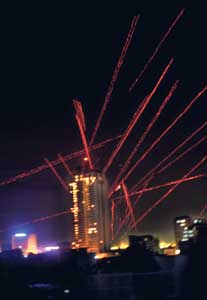
The Sunday Times photographer M.A. Pushpa Kumara captured this scene when Colombo’s night sky was set alight by anti-aircraft gunfire when two LTTE light aircraft hovered over the city and suburbs on April 29

February
9: President Mahinda Rajapaksa sacks three of his senior Ministers — Mangala Samaraweera (Ports and Aviation), Anura Bandaranaike (National Heritage) and Sripathi Sooriyarachchi (Port Development – non-Cabinet rank).

March
2: Five bullet-riddled bodies with faces disfigured and blindfolded are found in a swamp in Kandana.
10: The bodies of eight people, including the Anuradhapura Area Commander of the Army, Jayantha Suraweera, are recovered at the Wilpattu National Park.

April
1: Six labourers are killed at Mailambavani, Batticaloa, and hours later, 16 civilians and a soldier fall victim to a bus bomb blast at Kondawatturan, Ampara.
7: Seven including two children are killed when a state-run passenger bus is hit by a powerful claymore mine at Pirimanalankulam in Vavuniya.
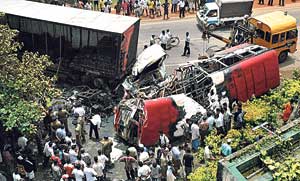
10: In a horrific accident which shocked the country, 23 people die and more than 50 suffer injuries when a beer delivery truck crashes into a CTB bus at Kaikawala, close to Bentota.
29: A total blackout is imposed on the city of Colombo shortly after midnight as two Tiger rebel aircraft hover over the area. The craft drop bombs on a fuel dump of the CPC oil installations at Kolonnawa and an LPG gas facility in Muthurajawela. The LTTE air attack comes as Sri Lankans are glued to their TVs watching the World Cup cricket finals in Barbados, with Sri Lanka taking on Australia. Rain dampened the match with Australia winning the World Cup.

May
6: Former President Chandrika Bandaranaike Kumaratunga’s security is slashed on a Supreme Court ruling.
18: Two small children and three other members of one family are hacked to death in their sleep, over a land dispute, in Meegahawatte, Delgoda. A 12-year-old girl who is critically injured is the sole survivor.
27: The de-merged Northern and Eastern Provinces get new flags. The Eastern Province flag depicts an eagle, a fish and a lion, signifying Trincomalee, Batticaloa and Ampara respectively while the Northern Province flag depicts the sun.
28: A claymore blast in Ratmalana kills eight and injures 30. The mine had been kept on the roof of a video shop at Belekkade junction.

June
1: A lorry laden with explosives weighing around 1,000 kilograms A?a??a?? is detected at a road block at Kotavehera, Nikaweratiya.
7: More than 300 Tamils are evicted from lodges in Colombo amidst strong protests and condemnation not only by human rights groups but also the international community.
8: Nine bodies of people killed, with their eyes blindfolded and hands tied behind their backs, are found at Wennappuwa.
9: Following a spate of abductions, ransom demands and killings, the Criminal Investigation Department questions a former Air Force Squadron Leader Nishantha Gajanayaka.
16: Sri Lankan Rizana Nafeek (19) is sentenced to death by a Saudi Arabian court after an infant she was bottle-feeding chokes. Rizana who was from Mutur had gone to Saudi Arabia in May 2005 at the age of 17 giving a false age on her passport. The appeal against the death sentence is pending.
29: ‘The Buddhist’, the first Buddhist TV channel in Sri Lanka is launched and goes on the air.

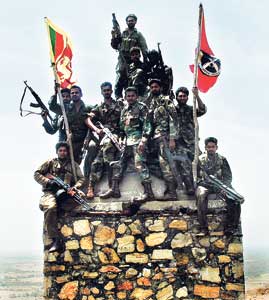
Troops celebrate the fall of Thoppigala, the last eastern stronghold of the LTTE, on July 11

July
11: The army captures Thoppigala, the last eastern stronghold of the LTTE, bringing the entire Eastern Province under government control in 14 years. The military claims that at least 211 LTTE cadres were killed.

August
1: The CWC resigns from the government and Leader Arumugam Thondaman gives up his ministerial portfolio.
9: The government expresses concern in Parliament over the statement of UN Humanitarian Affairs Chief John Holmes who in an interview with Reuters described Sri Lanka as one of the most dangerous places for aid workers.
12: Former Attorney General K.C. Kamalasabayson passes away while receiving treatment at Apollo Hospital in Chennai, South India. He is 58.

September
7: A new system for Grade 1 admissions to state schools is approved by the Supreme Court.
10: Malaka Silva, son of non-cabinet minister Mervyn Silva, who is alleged to have hit an accountant of a private firm with a pistol, is remanded.

October
5: Several high-rise buildings in Colombo are asked to switch off their exterior lights and key locations including the Colombo Port, the Bandaranaike International Airport and the Shell Gas facility in Kerawalapitiya are put on full alert after the sighting of two suspected LTTE light aircraft in Tantirimale near Anuradhapura.
11: The CWC rejoins the government with Leader Arumugam Thondaman regaining his portfolio.
14: Just as UN Human Rights Commissioner Louise Arbour concludes her fact-finding mission to Sri Lanka, four of the 10 civil society members (part of an advisory committee set up to address human rights concerns) resign from the panel citing differences with the government. Earlier, Arbour and Disaster Management and Human Rights Minister Mahinda Samarasinghe differed strongly on the need for UN monitors in Sri Lanka.

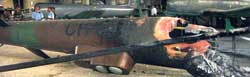
The Anuradhapura Air Force base after the Black Tiger attack on October 22

Sri Lanka’s sprint queen Susanthika Jayasinghe is in line for a gold and a silver for her performance at the World Athletic Championships in Athens, Greece, and the Olympics in Sydney, Australia, respectively both in 2000, with Marion Jones due to be stripped of her medals after admitting the usage of steroids.

15: The LTTE launches an attack on an army detachment at Thalgasmankada in Yala, killing six soldiers and injuring three. A massive military search operation is carried out. The National Park is closed to visitors.
18: Malaka Silva, son of non-cabinet minister Mervyn Silva, allegedly involved in an assault case is released on bail.
22: Several aircraft are destroyed or damaged when the LTTE’s Black Tiger unit attacks the Anuradhapura Air Force base.
25: The Manampitiya Peace Bridge, Sri Lanka’s longest bridge built across the Mahaweli linking the Northern and Eastern Provinces is opened by President Mahinda Rajapaksa.
26: The government suspends the licence of the Asia Broadcasting Corporation (ABC) for allegedly misreporting an incident at Ranminithenna in Tissamaharama.

November
1: The Supreme Court dismisses the application filed by ABC challenging the licence cancellation by the government
2: LTTE political head S. P. Thamilselvan is killed in an Air Force raid over Kilinochchi. Five LTTE military wing leaders are also killed in the attack. Thamilselvan was the LTTE’s chief negotiator at peace talks with successive governments.
Vinayagamoorthy Muralitharan alias Karuna is arrested in London for travelling under a forged passport.
More than 100 Sri Lankan soldiers serving with the UN peacekeeping mission in Haiti (Minustah) are accused of sexual exploitation and abuse including the rape of children.
7: The budget offers little relief to the public already affected by the soaring cost of living.
9: The Supreme Court issues a significant directive on noise pollution, banning the use of loudspeakers or any other amplifiers from 10 p.m. to 6 a.m.

Purchase lanoxin

The scene after a beer delivery truck crashed into a CTB bus at Kaikawala on April 10

12: A 22-year-old garment factory worker, Chamila Dissanayake, who had sought treatment at the Negombo Hospital, is found with critical injuries on a pathway close to the hospital. Police investigations indicate she had allegedly been pushed from the sixth floor by a doctor. Chamila dies while being taken to the National Hospital.
15: The United States freezes the US held assets of the Tamil Rehabilitation Organization (TRO), that acts as a front to facilitate fundraising and procurement for the LTTE.
17: Elina Jayewardene, widow of the first Executive President of Sri Lanka, J.R. Jayewardene passes away at the age of 94.
19: After weeks of speculation and tension that the government will not be able to get a majority and also crossovers, the second reading of the 2008 budget is passed in Parliament. The JVP votes against the budget.
21: The printing press of Leader Publications, which publishes the Sunday Leader, the Morning Leader and the Irudina, in Ratmalana comes under an arson attack.
29: Steven Peiris, Coordinating Secretary to Social Services Minister and EPDP Leader Douglas Devananda, is killed in a suicide bomb attack at the ministry office at Isipathana Road, Colombo 5. Two others are injured. For the first time, the attack is captured on CCTV and is possibly the only live pictures of a suicide bomber blowing herself up.
In the evening, like a sequel to a bloody story, 20 people are killed and 43 injured when a bomb left at the parcel counter at the Nugegoda NoLimit explodes.

December
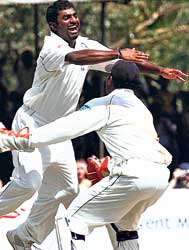
3: Muttiah Muralitharan breaks the record for the highest number of Test wickets reaching 709, when he dismisses England one-day captain Paul Collingwood during the third day of the first Test match at Asgiriya, Kandy. This match is also the last Test match of veteran cricketer, Sanath Jayasuriya who retires from Test cricket.
5: Fifteen civilians are killed and 23 injured when a powerful claymore mine blows up a CTB bus on the Anuradhapura-Janakapura Road close to Kebithigo-llewa.

Spin wizard Muttiah Muralitharan celebrates with wicket keeper Prasanna Jayawardene as he breaks the record for the highest number of Test wickets reaching 709.

8: In keeping with a Supreme Court ruling, permanent security checkpoints in and around Colombo are abandoned. The ruling that permanent checkpoints are illegal was issued after a motorist filed an application that he was harassed and unlawfully detained by police officers at Kirulapone.
10: On World Human Rights Day, several media organizations, civil society groups and trade unions march to the Media Ministry and hand over a petition demanding immediate action to curb increasing violence against journalists.
12: SLMC politicians including Leader Rauff Hakeem cross over to the opposition.
14: Foiling UNP plans to defeat the government, the third reading of the budget is passed with 114 voting for and 67 against. A while before the crucial vote, National Heritage Minister Anura Bandaranaike crosses over to the opposition but leaves Parliament just before voting. The JVP abstains from voting.
19: A newborn baby boy goes missing from the Kalubowila Hospital and is believed to have been stolen by a woman who had offered to look after him while his mother was having a bath. The baby is found by the Kohuwela Police in a house in Thalapathpitiya on December 24. However, another couple who lost their baby son in November from their home is still searching for him.

SriLankan Airlines CEO Peter Hill’s work permit is cancelled by the Board of Investment on the grounds that he failed to comply with a request from the main shareholder of the national carrier, the government. The request was for 36 seats from London to Colombo for the President and his entourage.
Flash floods and heavy rains in the Eastern, Central and North Central Provincesleave over 200,000 people homeless.
26: As the third anniversary of the devastating 2004 tsunami comes round, it is revealed that only US$ 1.7 billion of the US$ 3.1 billion pledged by foreign donors has been received and rehabilitation work is delayed.
27: Tension mounts at the state-owned Sri Lanka Rupavahini Corporation when Deputy Minister of Labour Relations and Foreign Employment Mervyn Silva and his bodyguards allegedly assault the News Director for not telecasting a speech made by him. When the staff attempts to retaliate, the Deputy Minister takes refuge in the Chairman’s office, until he is taken away under police protection.

source:
http://www.sundaytimes.lk/071230/Plus/plus00011.html

Naval News

Navy apprehends suspicious vessel – off Arugambay

Sri Lanka Navy apprehended a suspicious vessel located 90 Nautical miles East of Arugambay last morning, 25th December 2007.

According to Navy sources, the vessel which had been drifting towards the mainland was detected by Navy Sea units last morning.

How much amantadine to get high Purchase methotrexate ectopic pregnancy

Navy has already sent a boarding party to the ship and the crew is presently being taken to the nearest harbour for further investigations.

Navy personnel are now checking the ship. According to the reliable information the ship’s crew is comprise of Indonesian Nationals.

source:
http://www.defence.lk/new.asp?fname=20071226_02

“tri anni horribili”

Around this time, 3 years ago, we were still pretty wet.
But we were united, full of hope and full of confidence.
We even managed a swift and highly efficient self-recovery.

  • We had our very own reliable Early Warning System.
  • The Bay was covered with a high speed WiFi system, free to access by all.
  • We had a good medical clinic thanks to DEMIRA.
  • There was no talk of ‘Tamil’, Muslim or Sinhalese “Area”.
  • Above all, there was no war.
  • All was Then – Not Now.

In our personal experience, the natural flood event 3 years ago was nothing compared with the man made disaster which has unfolded since.

Still, the ‘great’ organizations are content with their ‘impressive’ achievements.
Take a look at two examples, published this week.

  • The Red Crusaders and Half Moonies dwell in glowing reports “From the Field”.
  • https://www.arugam.info/2007/12/25/from-the-field/
  • http://www.alertnet.org/thenews/fromthefield/220224/
  • 31b45032a6112e837bf489cb2a4d2cc1.htm
  • We, the actual victims, had no idea that the guys in plush offices in Colombo 7, such as their grand mansion in Gregory Road, are involved in agriculture Lopid online . But we do know that they tend to send their local staff near -but never actually into – the odd trouble zone. Whilst all ex pats remain near the Happy Hour and the up market ‘Bay Leaf Restaurant opposite on Gregory’s Rd. A excellent location to pretend that IRCS so-called management also do a highly ‘dangerous’ job “In the killing Fields”. This of course is a great tool to justify their high wages and danger allowances.

You can even get it for FREE. They stress. Who the hell would want this silly map, which shows no details at all and doesn’t even mention the hardest hit area Arugam Bay remains their own little secret.
A far better map was produced by the British, 60 years ago and this one is actually useful – but it does cost 75Rs./ at the Ordinance Dept. in Colombo. For this huge amount you actually receive an updated, modern version showing every telegraph pole.

  • Mercy Corps and Oprah Whinfrey are still boasting with the fact that they “changed our lives”.
  • Indeed, they did.
  • But just about everything is much worse than it ever was before in the Bay.
  • No matter. The popular, very clever Show is well in the clear. Financially.
  • Harpo Inc. collected huge sums in the name of Arugam Bay with their 3 shows.
  • A substantial surplus of many Millions was made, even after ‘reaching out’ by signing a cheque for 1 Mill. and walking away from our long term, Mercy Corpse created problems.

How blissful must it be, to be ignorant!

On one side the gullible donors are impressed with glowing and highly inflated claims of achievements.
On the victims side, where nobody has Internet access (Why?? We often wonder??), no one has an idea what is claimed abroad to have been done. In the remote little Bay.
Arugam.info, and also myself are (un-)lucky enough to be able to see and compare both sides.
And as they never seem to match we have seen it as our duty to report – directly from the Field. For three, terrible, long years we did just that.. If we don’t draw attention to this huge fraud, who else is to do so? It got us nowhere. On the contrary, we harmed ourselves and we would have done better to grovel and give in to their financial super power. Earning a few of the morsels they tend to drop to the greedy and their sympathizer’s.

So, who made all the difference?
Answer:
The small, simple, private people.
Exactly the kind of group, the BIG organizations wanted to keep out. Their advice was NOT to take matters into one’s own hand and leave the Tsunami help in their ‘experienced’ and ‘trusted’ hands.
Lucky for the Bay some did not listen and purchased a ticket and came to see, help and do what they could.
If it were not for great guys such as:

  • Nathalie, the party girl, who played with kids. Showed they that someone cared for them.
  • Tom the carpenter, who came with nothing but his tools and belief to assist
  • David le Sueur of Friends of Europe
  • Dutch girls Maria & Hanneke
  • Doc. Martin and DEMIRA,
  • Supem de Silva and the Rotary Club
  • Rasta Neelu and French Frederick
  • Per & Camilla from Danish Villa,
  • Steve of RoccoA?a??a??s fame
  • Members of SLB and Reisespinne
  • Wolfgang, the (then) webmaster
  • N.s.s. Simon, the Bay’s big donor
  • And many more

None of them ever had a vehicle fit for a Minister. Indeed, most relied on Public transport. Surprise, surprise: They all still managed to do a great deal more locally and all over the so-called ‘troubled’ East Coast than any Land Cruiser crew ever did or will do.
Without references to or demands for (non-existing-)danger money.
And all without a weird blue light on top. Or flag behind.

If these highly motivated, educated, critical and informed individuals would have been supported just a little more with some official funds (wasted daily) they are the ones who would really have changed lives to the better.

Instead, the large organizations regarded them as a threat, obstructed and even boycotted many. Most left, sad and demoralized, because they simply could not compete with (empty) promises, flash cars and elaborate lifestyles of the Great ones, which did impress and corrupt the local natives.

Most in the big organizations seem to regard their tasks as just another job. And although they may have started with great intentions they were soon grounded by their own bureaucracy. Only few had the back bone to resign in disgust. Such as Matthias from Koeln and Max Seelhofer, the Swiss Red Cross S.L country chief.
WE salute them all.

And we wish to thank our loyal, critical supporters herewith.
Without all of you great guys I am sure that some of the neck ties dropped of by the Red Cross 3 years ago would have found more than one non-intended use by now.
The US donated toilet rolls, which filled the entire “Hang Loose” Hotel at the time when we had no toilets, however, became useful after all, proving us totally wrong. A good motion.

Let us hope and pray that the next 3 years will not see are repeat performance of this mismanagement and waste of resources!

Below is just one Example.
This what we often see, locally.
Nothing at all has been done, apart from an erected sign!
Or even two…..
Example of Claim:

However, at least one organization had the neck to claim that they ‘completed’ a “Sanitary Project” in Arugam Bay. At huge expense. The trusting donors were content.
But, would they still be happy with their good deed? If they had been given the facts?
If they could have compared this grand “Project” with the REALITY, as below?
Example!

Maybe some of you can understand, why We are NOT happy with what we were forced to observe during the past Three, Terrible Years!

Happy New Year 2008!

Tsunami billions still at sea

Thousands of Victims still stranded 3 years after catastrophe
By Madhushala Senaratne

As Sri Lanka marks the third anniversary of the catastrophic 2004 tsunami, it has come to light that only US$ 1.7 billion of the US$ 3.1 billion pledged by foreign donors has been received. As a result of the shortage of funds and other reasons, thousands are still living in makeshift camps while rehabilitation work has been delayed.

According to Nation Building Ministry figures, there was a shortfall of US dollars 1.4 billion as against the money pledged for tsunami rehabilitation and related projects. Some of the agencies and governments had disbursed almost all the funds they pledged or were on the verge of keeping to their commitments, but others were lagging far behind. The money was pledged from more than 480 organisations.

Torsemide cost uk

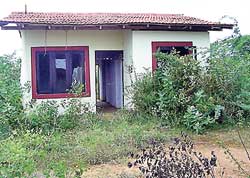
An abandoned house at a tsunami housing scheme in the south.

Of its total commitment of US$ 150 million, the World Bank had disbursed US$ 142 million while the UNICEF had dispersed its full commitment of US$ 42. 3 million. The USAID which had committed $ 115 million had disbursed $ 68 million. NORAD which pledged $ 1.2 million had disbursed $ 607,992.

At least 19,791 housing units still remain to be completed for those hit by the tsunami while in some cases there were people who received more than two houses due to uncoordinated distribution. A?a??A?Of the estimated 117,483 houses required, 85% of the work has been completed while the remaining would be completed by end of June next year,A?a??A? the ministryA?a??a??s tsunami housing projects director, Ramesh Selliah said.

Although 100% of the work has been completed in the Southern province, about 88% has been completed in the East, Mr. Selliah said. He said thousands were still living in temporary camps and were reluctant to move. He said the construction of houses in the northern and eastern areas was slower mainly due to the fighting in the areas.

BatticaloaA?a??a??s Additional District Secretary K. Mahesan, said reconstruction work in areas such as Vakarai was put on hold due to heavy fighting in the region and the subsequent displacement of thousands of civilians worsened the situation. A?a??A?However, over 90% of the required houses in the Batticaloa district have been completedA?a??A?, he said. In addition, much of the work in Ampara has also been completed.

However, maintaining an estimate cost for a house is becoming increasingly difficult with the rise in prices of materials such as cement, according to Sritharan Sylvester, Director of Caritas which handles human and economic development issues in the East. Limited funds, donors moving out of the East and the rainy season were adding to their woes, he said. In President Mahinda RajapaksaA?a??a??s homebase of Hambantota a total of 6,391 houses have been rebuilt and families resettled. This is in excess of the 3193 houses that were directly affected or damaged. A?a??A?The houses built in excess are now occupied by the indirectly affected people such as renters, sub families and extended families,A?a??A? Hambantota District Secretariat tsunami work chief Mahinda Manawadu, said.

But, some of the housing projects have been completed halfway and abandoned. The construction of 200 houses in Ichallampattu in Trincomalee undertaken by World Vision Lanka was stopped due to the conflict in the area. However, its National Director Yu Hwa Li said that they would resume work once stability is restored in the area.Meanwhile, a senior official of the Tsunami Education Rehabilitation Monitor (TERM) said that of the 183 schools identified as directly damaged, 100 have been rebuild so far. Work on the rebuilding of some 40 schools in the Jaffna, Mullaitivu, Kilinochchi, Trincomalee and Batticaloa has been put on hold due to security reasons while the work on the remaining 40 schools is to be finished next year, he said.

Phentermine hoodia buy

Certain projects implemented by the Japanese government in the East had also been delayed due to the prevailing security conditions. A?a??A?Although much of the work has been completed, including the reconstruction of Japan-Sri Lanka friendship villages in Trincomalee and Ampara, we faced many difficulties especially with regard to transportation of goods and equipment,A?a??A?, the Japanese embassyA?a??a??s second secretary Yasuhiro Watanabe said.
source:
http://www.sundaytimes.lk/071223/News/news0001.html

Return to Arugambay

By Dr Kavan RatnatungaThe consequences of Great Tsunami of 26th December still influence events in Lanka. I had visited the east coast of Lanka 5 days after the Tsunami and it was just over 5 months, when I got the opportunity to return to Arugambay to see how the population directly affected by the Tsunami have recovered. They have little time to ponder the larger issues of sovereignty which is currently dominating the media and tearing apart the government and it’s politicians bickering on how to safeguard Lanka and divide the billion$ of Foreign Aid promised for Tsunami relief.

As on the previous trip I joined Lt. Col. Anil Amerasekara. Wing Cmdr. Ranjit Ratnapala was also traveling with us to continue his quest to help the region in the name of his son Chinthaka, who had in June 1997 made the ultimate sacrifice in the defense of Lanka. We were joined in Kandy by Nisanka and Ira Madiwaka who had collected funds in UK to rebuild Tsunami affected houses in the east coast.

On Friday we visited three small computer centers near Ampara organized by the Thawalama organization and housed in Buddhist Temples. A computer technician Manjula came with us to fix problems and maintain the 5 computers in each center. A local teacher is hired to educate 5 batches of about 10 students each in English and Computer literacy. After the 6 months course they sit for an exam. We held such an exam on Sunday in one of the centers before returning to Colombo. The exam is set and marked in collaboration with Where to buy tamoxifen online IDM who awards certificates to those that pass (about 30%) and scholarships to those that do very well (about 1%). This program had been active now for about 2 years in eight centers in the North-East provinces of Lanka.

The Potuvil to Arugambay bridge, part of which had washed away in the Tsunami had reopened with the aid of the Engineering regiments of the Indian Army Task Force. An Indian Flag was hung on the side in gratitude, I wonder how long this temporary repair which allowed a single vehicle to be on the bridge at one time, will need to serve the community.


The entrance to temporarily reconstructed Arugambay Bridge
It was about 10 O’clock when we drove into Arugambay on our way to stay overnight at the Guest House in Kudakalli 2 km further south. A ghost town after the Tsunami just five months previously, Arugambay was alive at this late hour. Many Tourists had returned to this surfing paradise and were on the streets walking from their hotels to patronize the Cybercafe and many Bars and restaurants which had reopened. A street performance was entertaining a large audience near a newly constructed Buddhist shrine in the town center.


The infamous Tsunami Hotel sign, repainted with URL
The Tsunami Beach hotel sign had been revised and put back up proudly stating that they had open since 1999. The owners cashing in on on all the media publicity after the Tsunami had even registered in March 2005 an Internet domain tsunamihotel.com. It like the Hotel had still not activated.

Arriving at Daya Fernando’s guest house we surprised the caretakers since they had not got the message of our arrival. However dinner was soon ready and the mosquito nets put up for us to retire to sleep from a long drive. Since I had not slept overnight near the east coast for almost 30 years, I got up an hour before sunrise and walked out with disturbing the others. Daya’s 3 dogs were ready to protect me and show me the way. The surf was up but fairly calm. Starlight and a crescent moon illuminated the many shells that had washed ashore on to the beach. A couple were beach combing a rich bounty. I too picked up some beautiful large shells and coral. I was amazed to see the many striations of black sand on the beach. Considering that region of the beach needs to have been rebuilt after the Tsunami, black sand probably settles only at particular tide characteristics. I was disappointed by the clouds which covered the horizon at sunrise. The others were up and ready for breakfast by the time I walked back to the guest house.

Our next visit was to Panama. A small Sinhala community 10 km south of Arugambay. We went to the residence of Chandrasena who was the secretary to the local Pradesh Saba (community council). He is I was told a (s)pot-less politician. It was he who had compiled the list of 17 houses which had been badly damaged in Panama by the Tsunami and had sent out the appeal with photographs for funding. He told us that all off them had already been rebuilt by Thawalama using funding from Sri Lanka Tsunami Appeal Committee of Western Australia. I also witnessed the handing over of ten carts with pneumatic tires to cultivators affected by the Tsunami from this same committee.

The cultivators of Panama also lost over 350 acres of paddy land, when areas such as Halawa, close to the sea was flooded by Tsunami water. These Paddy fields will remain barren for many years till the salt washes away. Though they have been promised alternate land under the Meeyangoda tank, which is to be restored with funding from the Rotary Club of Kandy, the cultivators now fear that this too is another promise that will never materialize. Most NGO’s who have visited the village of Panama have requested the villagers to fill application forms, but have failed to provide the promised assistance.

In the reality that some promises of help for reasons beyond the control of the well-wishers get delayed or unfulfilled, construction starts when the first group comes with the hard cash. There have been some reported cases when more than one group have known to have paid for the same reconstruction.

That was clearly not going to happen here. The UK funding would need to be used for other housing project in Panama or elsewhere on the East coast. We visited some homes which although had only been slightly damaged by tsunami, the residents who had lost their livelihood to the Tsunami and their ability to complete a partial house construction. The decisions were hard to make with so many valid requests for help.

Nearly all of the help to reconstruct and revitalize the community has come from private organizations which have raised the required funds in Lanka and abroad. The government represented by the Task Force for Rebuilding the Nation (TAFREN) had still not made any positive impact on reconstruction the community. All that the residents have seen are the numerous reports and advertisements in the media of what is being planned, Those affected were wondering where all the claimed foreign aid had got tied up.

Just south of Arugambay, the village of Ulla, within the 200 meter buffer zone was totally destroyed by the tsunami. TAFREN has thus far failed to provide the affected families with alternate property outside the buffer zone, for them to commence rebuilding their houses. The NGO’s who want to help these unfortunate people to rebuild their houses are being discouraged as a result.

TAFREN unlike most NGOs allocates the task signs a MoU and waits. For example the Sinhapura Sinhala Vidyalaya in Ulla near Arugambay was totally destroyed by the tsunami, even though it is beyond the 200 meter buffer zone. The Italian Civil Protection Mission has signed a MoU to complete construction work in six months. It is now six months since the tsunami and they have yet to commence work on reconstruction. The Thawalama Development Foundation that wrote to the President in this connection, requesting her to reallocate this school to them, as they are in a position to find the necessary funds for the purpose, have been informed by TAFREN that this is not possible.

Unlike state aid, private aid has in many cases been made on racial and religious divisions. A Tamil resident from Jaffna I spoke to said that although many who didn’t have any fishing boats have received a one, but he who had lost seven boats in the Tsunami has still to get any replacement.

That evening we visited the “Mudu Maha Vihara”. We were surprised to find that the archaeological dept. sign that pointed the way for pilgrims and tourists had been removed and replaced with a large Mosque sign which at bottom mentioned an unnamed archaeological site. An interesting report that circulated soon after the Tsunami was that a reclining Buddha statue had been seen few hundred meters from the coast when the sea receded near the Vihara. The Monk who was in residence on the fateful day, said that no such statue had been seen. The story had been made up to say that the 34 acres of land allocated in the 1960’s to the Vihara as an archaeological reserve is from the sea, and not the 30 acres of archaeological land illegally encroached by the local Muslim community.


Buddhist Monk explains the history of MuduMahaVihara next to statue identified as that of King KavanTissa.
This great Buddhist temple near the sea dates back to the 2nd century B.C. and has ruins and many sculpture from that era. It is stated in the ancient chronicle the “Rajavaliya” that in the second century BC after Kelaniya was submerged by the sea (Tsunami), Devi daughter of King was cast to sea in a Golden Vessel to appease the gods, and washed ashore near a Vihara to became queen to king KavanTissa under the name Viharamahadevi. Kirinda which is a lot further south and this site each claim to be the “true” landing site. Local folklore relate place names Komari to “Ko Kumari” (where is Princess) and Arugambay to reply “Ara gamme” (In that village)

Early next morning observing that the sky was still too cloudy to see sunrise, I went on a bicycle to photograph Arugambay and the reconstructed Bridge at dawn. The village was as empty as when we had walked that way five months previously. All of the rubble had been cleared. However various Political forces with wildly different agendas were preventing the start of the urgent Reconstruction.

After breakfast, packed and on our way out of Arugambay, we distributed baby T-shirts sent by the Senahasa Trust of UK. Although we had sent a message the day before through a local contact that we would be distributing free T-shirts to Tsunami affected families, no one had come when we arrived a bit early. I guess they had probably been disappointed before. A reasonable crowed of mothers with babies gathered after we arrived when word spread in village. We were glad we realized before trying to distribute them that the sealed T-shirts marked 6-12 was months not years as we had first assumed. Although all of the T-shirts were for babies under 2 years, we found some small built 9-years olds who fitted into them comfortably. To ensure that the T-shirts went to kids and not the local store, we insisted that the babies be present despite some legitimate comments from some mothers who didn’t want to bring their babies in the hot sun just to get a T-shirt.


Has the charm Arugambay Hillton to be demolished for the 5* Original
Talking with the villages at that time I was told that TAFREN with the Ceylon Tourist Board is trying to acquire a 17-mile long strip of the best sea coast on the pretext of a Tsunami 200 meter buffer zone, for development of a upscale resort of with five-star hotels, displacing the residents and small business who have occupied this land for generations. This amazing outrage is in detail by John Lancaster in a Washington post Proventil inhaler over the counter article of 6th June. The people of Arugambay must surely be feeling like they say in Sinhala “Like a man fallen from a tree, getting butted by a bull”


An edited version of this article Slow relief but surfers are back By Kavan Ratnatunga appeared in the SundayTimes of Sri Lanka on 2005 June 26th. The printed copy of Newspaper included Photographs shown above and not included in online edition. Access to the Online edition of the SundayTimes of Sri Lanka requires a paid annual subscription.source:
http://lakdiva.org/tsunami/arugambay/

2007 Capture Competition

The grand Arugam Bay Order zenegra photo Competition price of 2007 remains unclaimed!
Even a regular visitor to the Bay, having won 2 weeks Free B&B for two in an a/c suite, did not visit the Bay this year. It has never been as quiet as this before!
Order lisinopril hydrochlorothiazide AbHa has decided to extent the offer to redeem for one further year, hoping to welcome brilliant photographer Mr. Philip sometime in 2008.

How about a capture contest?
Below are a few amateur shots, all taken around the same location.
During the past 3 years.

AbHa, trying hard to attract tourists thinks the few photos sum up the “progress” of the past three years rather well, without many words. And show the conflict of interests in the Bay these days.
The winner of the most apt, funny or fitting capture will win a chance to run up and down Arugam Bay beach (just 2km) and try to match the amount of vessels with the slogans painted upon them.
At our expense.
Simply click “Comments” and let us hear your suggestion.

2004 View to Beach

December 2004; a Natural Event

Clean Arugam Bay April 2005

April, 2005. A fine balance is still in place

Outlook 2005

2005: Is this what tourists come to the Bay for?

Outlook Dec. 2007: After NGO

YOUR Suggestions Please!

Sami and Mere at Arugam Bay

Landing in Lanka

They say Sri Lanka is a jewel of an island, filled with smiling people and breath taking nature. From our experiences of the past few days, we are pleased to report that they are not wrong.After arriving at the ungodly hour of 5am, and, eventually, amongst a mountain of luggage, seeing our backpacks sheepishly appear on the luggage belt, we made the hour long journey into Colombo. Once there, we went to our friend Dixie’s house, one highly neat dood. Brilliant photographer. UN worker. Inspiring conversationalist. At Casa de Dixie we caught up on old times as well as much needed sleep. We also met some other super nice UN and NGO people, whom we played water polo with at one of the snazziest hotels in the country, The Blue Water.

Then, in the bumpy backseat of a genuine white UN 4×4, we had a thrilling ride across the entire breadth of the country, along some tear jerking vistas and sheer drops on the winding highland roads. After some 10 hours we ended up at the secluded Surf gem of Arugam Bay. There, in our hammocks, we chilled for a few days at a fantastic beach front surf place, the Galaxy Lounge, complete with delicious food and plentiful beers.

As a whole, Sri Lanka is full of vibrant, happy, polite people, who are keen to introduce themselves and to learn more about other cultures. Without fail, this has been the case for everyone – whether Sinhalese, Tamil, Muslim or other.

Despite a sad collapse of the cease fire and a tragic return to what can only be described as full out civil war, the country feels strangely safe for foreign travellers. In fact, from what we’ve been told so far, the biggest threat are the many super duper poisonous snakes. Eeek. They are presumably waiting for Sami to wander into the tall grass for a drunken late night piss. So far we’ve only seen one King Cobra, but it was far scarier that any high security zone, military checkpoint or Kalashnikov wielding camouflage soldier.

Tomorrow we’re accompanying our buddies on a second UN mission, this time a trip to document a much needed road project that connects remote villages in the dense East Sri Lankan jungle.

In the next few days we’ll probably be back on the South Western Coast, the epicentre of unashamed decadence and worryfree holiday drinking. No doubt, having had this unusual priviledge of seeing the hidden eastern areas of Sri Lanka will certainly make our relaxing even nicer. We can only hope that one day this country will see peace again and that this gem of an island will get what it deserves.

S&M

source:
http://samiandmere.blogspot.com/2007/12/landing-in-lanka.html Cheap prinivil lisinopril Price of levitra at costco